
“A gem cannot be polished without friction, nor a man perfected without trials.”
― Seneca
Human nature is a very strange phenomenon.
Between life experience and stories from the past, there’s certainly no shortage of intrigue and insanity surrounding the experience that we normally refer to as human nature.
After all, the whole concept of human nature is a mystery because the entirety of the human race in which this concept references often serves to be a constant contradiction. I mean on one hand, people are unpredictable while simultaneously being very predictable. As an example, people can react to one situation with a surprisingly positive deference, but when faced with the same scenario again at a different time, they can demonstrate complete defiance.
However, as strange as this sounds, people are generally fairly predictable up until the point that they aren’t.
So, with that being said, what typically causes people to be unpredictable?
Generally speaking, I believe one good explanation for this can be chalked up to what I would usually recognize as the concept of friction. I say this because when people are faced with hardship, that adversity will either stall out their momentum in life by causing them to implode, rather than choosing to face and overcome the resistance they encounter concerning that initial friction. Granted, friction can also change variables, and variables can, at times, present different challenges depending on the time that they are introduced.
You see, in physics the only thing that can overcome friction is the increase of an externally applied force. If force is not applied then the friction will always slow down an object and eventually bring that object to a stop. This is true in physics, as well as across an array of other decisions when overcoming the friction of adversity in life, when wrestling with whether to make certain key investments, and with always involving other big important life decisions. I know you know this to be true.
I want you to hold onto this for the moment while I shift gears to talk about how the friction of life can cause people to engage in some of the most insane behavior. Granted, if you’re a regular to this show then you’re no stranger to understanding just how insane life can get as a result of human nature.
After all, when speaking to the oddities of human nature, you and I are both old enough to remember seeing people out at public restaurants lifting and lowering their masks between bites to eat a sandwich. We both know that we don’t have to look any further than the pandemic to understand that a potential level of strange behavior definitely exists.
Two Tales of Friction
In the world of human interaction, friction can cause some people to not follow through on action, while it ends up driving others directly into action. Granted, some friction is necessary to avoid, but there are other types of life friction that simply cannot be ignored.
I want to begin by highlighting two different tales involving the friction of life and show you how that friction can derive two totally different responses and outcomes from people. The key component here is to keep in mind that none of us are immune to the friction of life.
Now, I want to take you back in time to examine an unusual case concerning an individual that was faced with significant friction, but allowed that friction to slow him down and stall him out in the most bizarre and shocking kind of way.
In August of 1392, a 23-year-old King Charles VI rode out ahead of his army on an expedition. At this point, the young king was already feeling the presence of friction as he was paranoid about traitors within his circle. To make matters even worse, the purpose of this expedition was to try and track down an individual who had attacked and nearly killed his close friend. Revenge was weighing on Charles VI, so friction was already present in the young man’s mind.
As his army rode along and finally exited the forest an exhausted page boy accidentally dropped his steel lance and the loud clanking startled the hyper-vigilant king. At this point Charles drew his sword and entered into a blind frenzy resulting in him brutally slaughtering four of his own knights. By the time it was over Charles had fallen into a multi-day coma. He psychologically never recovered from the guilt and horror of his actions on that day.
However, as bad as that was for the young king, the friction of life was still not finished with him. It was only about five months later when another violent trauma occurred during a masquerade celebration. At this event Charles and five other of his high ranking nobles dressed as “wild men” donning highly flammable linen costumes that were soaked in pitch and flax.
During this event an onlooker with a torch got too close to the men and the costumes instantly ignited. Charles only survived the catastrophe because his aunt, the Duchess of Berry, threw her heavy skirts over him to smother the flames before they could spread any further. However, Charles had to watch in total horror as four of his closest companions burned to death directly in front of him at the center of the gathering.
Sadly, these two back-to-back catastrophes ended up permanently fracturing the king’s psyche. It was at this point that something unusual took place with the king as his severe paranoia developed into what is now referred to as the famous glass delusion.
If you’re not familiar with this condition, it relates to how the king believed that he was made of glass. It has been said that the condition was so real to the king that he even had his royal tailor sew iron rods into the lining of his clothes. Even though the king obviously felt there was no escape from this, he apparently only ended up in this predicament due to his deficit of intuition.
Historians and psychologists have pointed out that this condition of glass delusion was essentially a coping mechanism in order to protect his deeply traumatized, “fragile” sense of self. In short, King Charles VI tragically surrendered his sovereignty over to the life friction of fear.
It was bad enough that the young king had experienced trauma, but the fact that he surrendered his mind and identity over to the glass delusion added another layer of tragedy to the story of his life. Looking at the life of King Charles VI there’s no doubt that the friction of fear was the ultimate symptom of destructionism.
Now, I want to take a moment to shift to a different story to address another case where the friction of life showed up to try and grind another man’s momentum to a halt.
It was the year 1095 and the rapid conquest and expansion of the Seljuk Turkish forces into Anatolia was successful in shattering the Byzantine defenses.
The goal of this Islamic conquest under the Seljuk Turks was to strip Christendom of vast territories, which, in turn, prompted Pope Urban II to issue a historic call to arms at the Council of Clermont.
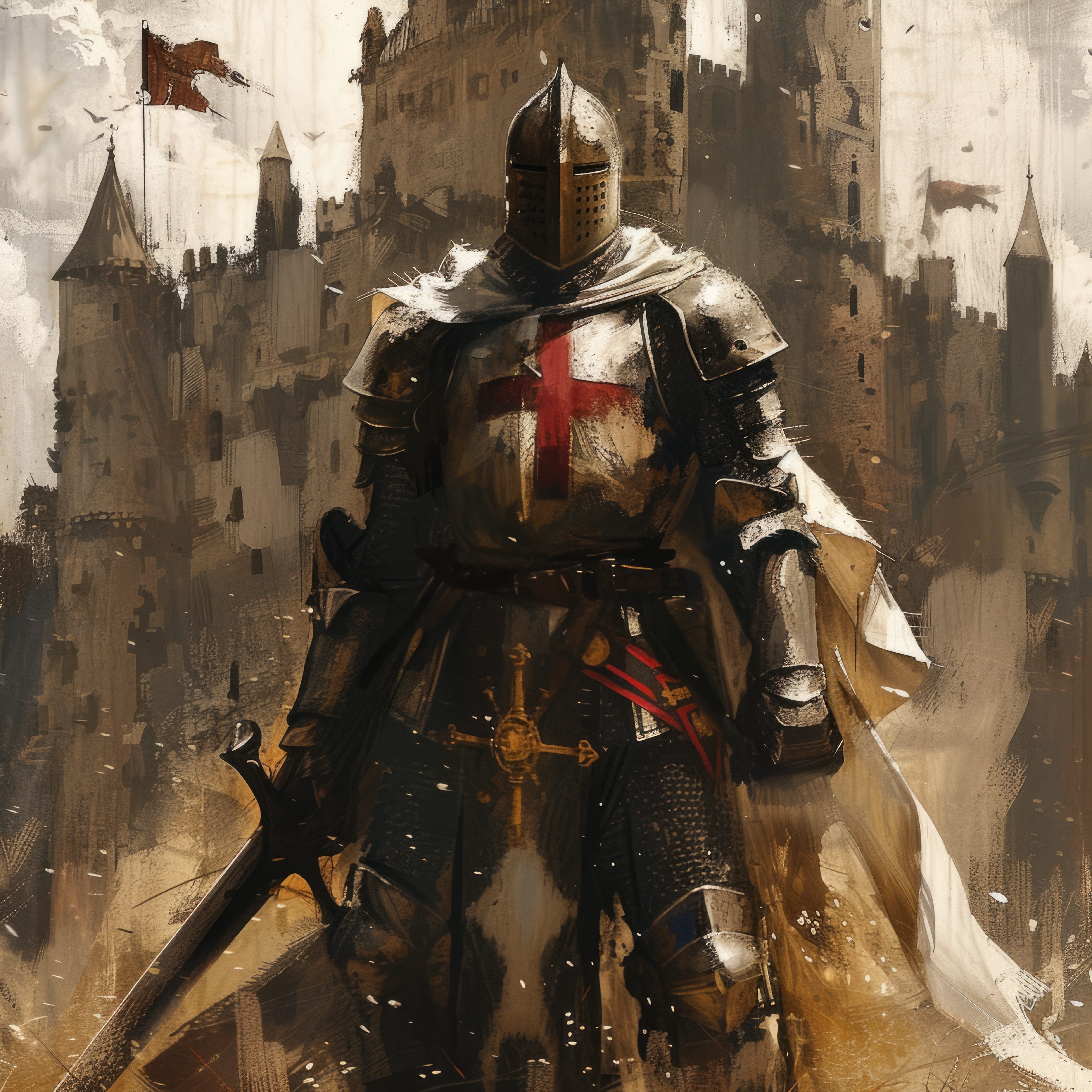
On the heels of the Pope’s call to arms, and with the Islamic conquests engaging in severe and violent brutality across the Holy Land, a tall blonde Norman giant with Viking blood, heard the Pope’s rallying cry and he viewed it as his personal call to divine destiny.
This blonde giant’s name was Bohemond I, and he immediately decided to journey east to create some friction of his own by engaging the Seljuk Turks, aiming to grind their violent conquest to a screeching halt.
As it turns out, Bohemond was driven by a fierce, militant Christian devotion. This was significant because after engaging the Seljuk Turkish forces in eight grueling months of wall warfare, Bohemond’s will and his faith would be put to the test. The friction of life was very present here for Bohemond and his men. The suffering was immense as Bohemond and his forces had to endure the harshest conditions involving severe weather, disease, and death.
The walls would prove to be too difficult to breach, but what Bohemond was unable to overcome by force, he managed to accomplish through his cunning.
Late in the evening around midnight of June 2, 1098 Bohemond was successful in enacting a secret pact with Firouz, a disgruntled tower commander from within the city. As a result of this pact, Bohemond was able to convince Firouz to drop a rope over the side of the wall allowing the Crusaders to finally scale it.
Once Bohemond’s Norman knights were inside they slit the throats of the guards and they were able to quickly sling open the city gates from within. The Crusader army rushed inside like a tsunami and conquered the Muslim garrison by dawn.
However, the victory celebration on this mission would be short-lived as a massive Muslim relief army under the command of Kerbogha surrounded the city managing to trap the exhausted Crusaders inside. It appeared that the build up of more friction was facing the Crusaders once again.
However, the strong-willed Christian viking Bohemond would not be denied. In a single bold decision, Bohemond ordered a desperate, all-or-nothing attack charging his men out of the gates. Bohemond himself was clad in iron and riding ahead of the vanguard. His towering frame and leadership was essential in rallying his starving knights straight to victory.
Through his militant discipline and faith, Bohemond, secured his reputation and place in history as the Prince of Antioch as he fulfilled his duty in taking back the city from the Islamist who stole it.
So, what is the significance of me sharing these stories of two individuals that each faced the drag of life friction, yet, when faced with this friction, produced very different outcomes?
Well, the reality is that there are a few reasons.
For starters, when looking at the lives of King Charles VI and Bohemond I, there are some key differences that stand out in regards to the two. In observing the comparative metrics of these two men, I am going to frame their scenarios and outcomes through my lens as a sovereign operator.
In other words, when examining the differing outcomes of both men there is a stark difference concerning their reactions when faced with some significant life friction.
In the case of the young King Charles VI he created friction for himself that he couldn’t deal with due to his own paranoia and fear. This ultimately imprisoned him by keeping him in a state of perpetual stasis. In other words, he ultimately kept himself wrapped up in his own version of a protective bubble, having his royal tailors line his clothing with iron rods. At the end of the day, this perpetual stasis resulted in the destruction of his own cognitive sovereignty, as he became a prisoner of his own mind.
On the flipside, Bohemond also created friction for himself; however, his approach to dealing with it wasn’t driven by haste, fear, or paranoia. Instead, his reaction to the friction of conquest caused by the Seljuk Turks was rooted in a sense of duty, righteousness, and, quite simply, a love for his fellow man.
Directionally, Bohemond possessed a completely different perspective and strategic approach to overcoming the friction he was voluntarily venturing out to encounter.
Unlike the young King Charles, in Bohemond’s case, his call to encounter the friction that was created by the Seljuk Turks wasn’t due to a one-off misunderstanding or incident. Bohemond was answering a call to arms that was essential to the survival of the Crusade. In short, he recognized his cause as something much larger than himself, or any other single individual for that matter.
Remember that stasis is the desired final outcome of friction. In the case of King Charles this stasis was achieved when his fear and paranoia gripped him to the point of identifying with the glass delusion. However, stasis was completely ignored by Bohemond and his forces, despite the amount of friction the Seljuk Turks tried to create for them. The contrast between these two tales of friction couldn’t be more stark.
In a modern-day comparison, we have also more recently observed similar differences in the reactions people had towards the friction that was created by the Administrative State during the pandemic. Like King Charles VI, many people simply wrapped themselves in their own bubbles by complying with the government mandates to self isolate, social distance, and to wear masks.
However, a stubborn minority chose to react to this situation in a completely opposite manner. Those that resisted the mandates reacted by choosing to increase in force and velocity against that very friction of governmental mandates.
These people recognized that they needed to do so in order to overcome the effort of that friction to grind their liberties and lives to a complete stop. In this modern-day comparison, many of the compliant succumbed to the grip of fear that spread as a mass formation from their own version of a glass delusion concerning the virus.
In short, while the majority reacted to the friction of government during the pandemic as compliant stasis, others looked at it through a similar dutiful lens as Bohemond did by fiercely fighting to take back possession of that which was wrongfully stolen.
The Wrap Up
Since the pandemic, these days we are currently facing a different kind of friction when it comes to the Red-Green alliance between the cultural Marxists and the jihadists. With this alliance we are facing an ideological friction that aims to destroy Western civilization.
When I talk about a different kind of ideological friction, I’m not implying that the core tenets of Marxism are any different from what we’ve faced before. However, what I am saying is that, in this modern-day, the appearance of this ideological friction has changed to look very different from what we’ve been used to encountering in the past.
In other words, the appearance of the “jihadists” and “cultural Marxists” have morphed over time in order to better blend in within their respective environments. Like chameleons, these people take on a certain form so that they give off the appearance of being reasonable human beings, while the reality is that they’re the furthest thing from it.
As an example, the modern-day Marxist-jihadist is an ideological chameleon that dons a nice suit and learns a polished script to communicate to the masses so that he can become the mayor of New York City. Obviously, I’m talking about Zohran Mamdani.
However, we’ve also discovered that even though these Marxist-jihadist don Western clothing and express interest in Western culture, at the end of the day, they’re far from sharing what you and I would recognize as Western values.
These Marxists-jihadists chameleons include that soccer mom that lives two doors down from you. They also include that seemingly nice, retired baby boomer on the corner whom everyone thinks is a swell guy, until a zenith operator exposes his worldview with the application of a little Organizational Hierarchy of Thought during a personal interaction. Such exposure always comes in scenarios such as this, as it always highlights the adversarial views these people hold towards President Trump and the MAGA movement.
One of the main reasons why the U.S. is facing contested dominance by the CCP is due to the fact that our society has failed at recognizing these threats, but more specifically, how these threats work.
For instance, this is why the woke right is quick to blame President Trump for the current spike in energy prices, while conveniently ignoring the past half century of corruption by establishment Washington, D.C., politicians, combined with their failure to hold Iran and China accountable for anything.
This is why certain voters (like the Marxists and the woke right) will see the current chaos spreading throughout the world and then complain about what’s happening, while they’ve lived a lifetime of apathy, completely ignorant of the cumulative buildup of corruption that has seeded this very chaos.
Yet, an Operational Zenith can look at these people and completely understand that if they didn’t recognize the friction that was built up over the course of their lives, leading to this moment, then they’re certainly not going to recognize that this same friction is what is working against them to stop the momentum of their lives now.
This past week President Trump traveled to Beijing to meet with President Xi Jinping. At one point during the meeting Xi had described the United States as a declining nation.
As part of that declaration he referenced the geopolitical theory known as the “Thucydides Trap” which reflected the idea of a rising China challenging the established global superpower, the United States.
Granted, during the Biden regime, the United States was absolutely a declining power. However, that is certainly not the case today.
Now, having said that, we have many problems to fix, or we will quickly return to becoming that declining power. The trick is understanding what those problems actually entail, along with the American citizen understanding what it’s going to take in order to fix those problems.
When the Iranian regime continues to prolong this current conflict, they understand very well how that is impacting gas prices. They know that Americans will not have the patience to endure that discomfort for very long.
Furthermore, when Xi Jinping references the Thucydides Trap he is placing a verbal exclamation point at the end of that same idea as the Iranian guard drags out the conflict in the Strait of Hormuz.
Additionally, they see how our Administrative State Media (ASM), Democrats, and anti-Trump RINOs are trying to bleed support away from President Trump and the MAGA movement in hopes that they can get those cohorts back into power come this November in the midterms.
Both Xi Jinping and the Iranian guard are counting on the Fifth Column activists inside the United States to politically drain the support of President Trump and the MAGA movement. They are doing this so that the corrupt establishment in Washington, D.C., can retake power, allowing them to exploit the return of this traditional, longstanding, business-as-usual style of corruption.
As a result of years of unabated corruption, grift, and enemy infiltration, we are now entering into a period of time where the culmination of these factors are building up to a point of critical mass. When this all finally comes to a head we have to ask ourselves if we’re going to rise to the occasion to meet that moment with a sense of duty just like Bohemond, or are we going to adopt another form of glass delusion that entraps us forever in a thousand years of darkness?
As I stated earlier, in physics the only thing that can overcome friction is the increase of an externally applied force. However, if that externally applied force is not building momentum then friction will grind everything to a complete standstill.
However, in the reality of the circumstances that we’re currently living in, the American Patriots represent that externally applied force. The question is: Are we going to continue on building up the application of that force in order to overcome that friction, or will we regress into a state of stasis while failing to break free from the grip of fear due to our own made-up version of a glass delusion?
I mentioned earlier how the friction of fear was the ultimate symptom of destructionism. However, I’ll be discussing the remedy for that concept with the Destructionism of Destructionism in my next strategic drop titled, The Forensic Assassin of Ideology.
Remember, elite car enthusiasts don't walk into the Ferrari dealership to haggle over the price tag. They understand the value of the horsepower and the Rosso Corsa they're getting when they've test driven a finely tuned machine. Today’s episode was your sovereign test drive.
Therefore, to achieve full cognitive acceleration, along with gaining full access to my next briefing, make sure you Upgrade To Zenith Status Now with a $50 annual commitment and join the rest of the Vanguard by clicking on the button below.
Remember that this is a reader-supported publication so make sure you give this article a like, subscribe, share, and comment to support the message.
Also to connect with me, join me here on Facebook, GETTR, Truth Social, and now Substack’s new social media called Notes.
Stay strong. Stay focused. Stay active.